


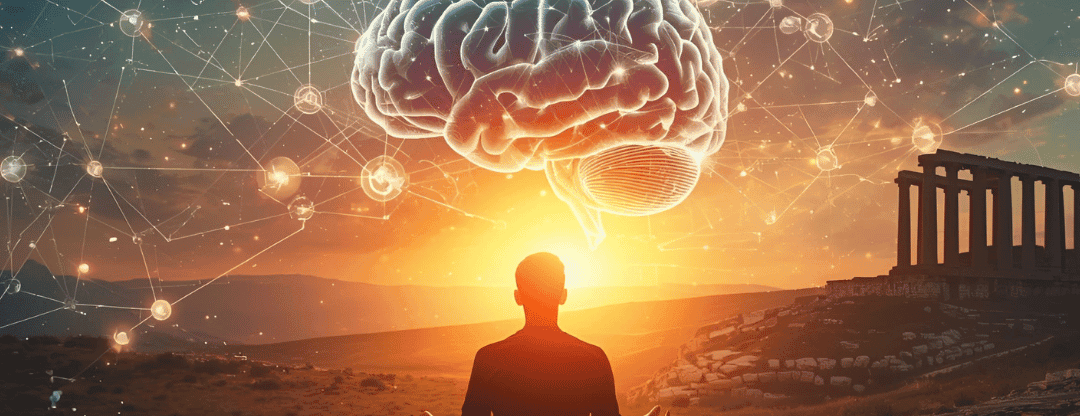
What science, the brain and ancient wisdom teach us about expectation, awareness and change.
There is something special about microdosing. Not only because of what it does, but also because of what people expect from it. Some users experience more happiness, calmness, focus and creativity, and some notice little to nothing. And increasingly, the same question pops up: how much of that effect comes from the truffle itself, and how much from our own minds?
Is microdosing partly placebo? Or, on the contrary, is intention an indispensable part of the effect?
In neuroscience, the power of expectation has been studied for decades. Placebo literally means ‘I will please’ - but in modern terms it is about something else: the way our brain responds to belief, hope and attention.
When someone believes a drug works, it activates specific brain regions that release the same neurotransmitters as the drug itself. With painkillers, you see this in the release of endorphins. With antidepressants, it's serotonin. Microdosing is all about the same principle: the expectation of openness, calmness or creativity triggers those networks even before the psilocybin does its work. That makes microdosing not a placebo, but a collaboration between substance and consciousness.
The brain does not act as a camera recording reality, but as a predictor. It constantly tries to guess what will happen, and directs the body accordingly. So if you start with a clear intention: ‘I want to learn to listen’, ‘I want to bring peace to my mind’, you programme your brain in that direction.
Imperial College London research (2021) showed that subjects who thought they were getting psilocybin but received a placebo still reported clear improvements in mood and creativity. At the same time, brain scans showed that psilocybin does cause a unique form of functional flexibility: networks in the brain communicate more freely, loosely, creatively.
Microdosing with magic truffles is not a placebo because the active substances - psilocybin, psilocin, baeocystin and norbaeocystin - have been shown to act on the serotonin system in the brain. Even in small doses (microdosing level), they directly affect receptor activity (especially 5-HT2A), causing a measurable change in brain activity and emotional processing.
What we see in addition is that intention and mindset can determine how someone experiences that change. Biology provides the opening, the enlightened feeling, the increased mental flexibility, but intention determines what someone does with that opening.
For example, if someone is depressed, microdosing can indeed lead to increased lightness, energy and resilience, even without conscious expectation. That effect is neurologically explainable and repeatedly demonstrated in studies (such as at Imperial College London, Johns Hopkins, and Maastricht University). Microdosing works. Full stop. Not because you believe in it, but because it acts on your brain. The substances in magic truffles enable new connections, literally. You can't stop that. Intention helps direct that change, but the effect itself is pure nature.

After more than thousands of microdosing processes within MicrodosingXP, we see the same pattern: people who start without a clear intention often become disappointed or restless. Those who start with a clear but soft goal, for example ‘feeling more connected to my environment’ or ‘making space for creativity’ notice subtle, lasting changes.
Intention acts as direction. Not as a goal to achieve, but as a compass that gives meaning to the process. The truffle opens the window, but you decide what you look at.
From a neurological perspective, microdosing creates a state in which the brain temporarily follows less rigid patterns. The default mode network, the part that controls habitual thoughts, becomes slightly quieter. This gives room for new connections, ideas and insights.
From a spiritual perspective, you could say: the mind relaxes its grip on reality. You become a spectator of your own thoughts, instead of being caught up in them. This experience is very similar to what happens in meditation, breathwork or rituals, only here it arises through a natural substance.
The truffle is not a gateway to something outside yourself, but a key to the inside. Intention determines whether that key opens a door or stays closed.
The line between placebo and potency is thin and perhaps even artificial. After all, what is placebo really other than proof that consciousness is a biological force? The intention with which you microdose is not an afterthought; it is a form of active participation.
The difference between ‘I take something to get better’ and ‘I listen to what inside me wants to heal’ is huge. In the first case, you expect the truffle to do something for you. In the second, you cooperate with what it offers. That's when microdosing shows its true potential.
1. Start with silence. Before each dose, take a minute to feel how things are going.
2. Formulate softly. Not goals like ‘I want to stop fretting’, but ‘I give my head a rest’.
3. Observe without judgement. Microdosing works subtly; observe mood, energy, focus.
4. Write or share. A journal or coaching conversation helps make insights concrete.
5. Trust process. Each cycle brings something different. Expectation is good; control is not.
Intention is not a magic word, but a signpost. Without intention, microdosing remains an experiment. With intention, it becomes a journey.
Whether you call it placebo or potency matters less. More importantly, we continue to recognise that consciousness and nature are not mutually exclusive, but rather reinforcing. The truffle works and you cooperate.
Read more about Microdosing XP: https://microdosingxp.com/nl/microdosing-xp/ or take a look at our points of sale: https://microdosingxp.com/nl/verkooppunten/
