


A shifting landscape
Microdosing in the United States is growing. More than 11 million Americans report use, according to recent research.
In the United States, microdosing is becoming increasingly visible within the broader conversation around psychedelics. Research suggests that at least 8.4 million US adults are estimated to have used psilocybin in the form of microdosing at some point.

Moreover, within recent users, microdosing seems to be more common than among people for whom the use was longer ago, although the interpretation remains ambiguous. Some of the respondents said they were not sure whether their last experience could be considered microdosing.
What emerges in these data is not a tightly defined phenomenon, but a practice that is slowly expanding, borne of diverse motivations often described in relation to physical and mental experience.
Recent publications, including research institute analyses and journalistic summaries, show that psychedelic use in the United States cannot easily be reduced to one type of user or one clear motivation. The field seems to spread across several domains, from curiosity to more contemplative forms of exploration.
What figures show
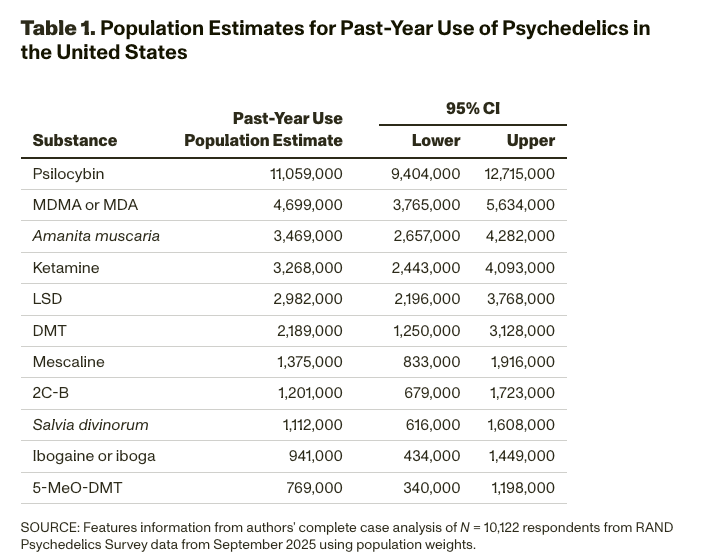
Research and media reports refer to numbers as high as millions of Americans reporting experience with microdosing. These figures are often based on large-scale surveys in which respondents themselves describe their behaviour.
Self-reporting introduces a certain stratification. It records not only what people do, but also how they interpret it. What falls under microdosing for one person may mean something different for another. As a result, the term functions as a collective term rather than a tightly defined category.
Yet an outline is emerging. Microdosing seems to be present in diverse layers of society. Not limited to a specific group, but visible in different contexts. Sometimes in creative environments, sometimes in technological sectors, and sometimes in more mundane situations less visible in public descriptions.
The role of science

Academic literature attempts to follow this development. Studies available through academic databases show a field still under construction. Studies differ in scale and design, moving between observation and experimentation.
Some studies focus on self-reported experiences, where participants describe their observations over long periods of time. Other studies try to create conditions in which variables can be better isolated. Both approaches bring their own limitations and opportunities.
What is striking is that microdosing is rarely reduced to a single mechanism. When it comes to psilocybin-containing fungi and truffles, there is more often talk of an interplay of substances. Not one dominant compound, but a complex set of components present together.
This is often referred to as the entourage effect. A term that tries to capture that the experience does not come exclusively from one molecule, but from the interrelationship of different substances. Within that perspective, magic truffles remain a natural product. Not an isolated substance, but a biological whole in which several compounds are present simultaneously.
Between expectation and experience
Besides scientific publications, opinion pieces and essays appear in which microdosing is placed within broader societal questions. In these, the focus shifts from measurability to meaning.
Microdosing is sometimes described as an attempt to explore small shifts. Not as something immediately visible, but as a subtle change in perception or perspective. In these descriptions, expectation plays a role that is hard to separate from experience.
What someone thinks they are experiencing can become intertwined with what is actually perceived. This interaction makes the subject less unambiguous, but at the same time opens up space for different interpretations. It is not fixed, but moves with context and perception.
Culture and context
The development of microdosing in the United States is not separate from the cultural environment in which it takes place. Some stories refer to technological and creative sectors, where experimentation and curiosity converge.
At the same time, there are other contexts in which microdosing takes on a different meaning. Sometimes more introspective, sometimes more practical. Sometimes linked to personal routines, sometimes precisely to temporary explorations.
Psychedelic substances have a longer history in different cultures. Often embedded in rituals and collective structures. Microdosing seems to be moving away from that. Less tied to tradition, more spread across individual approaches. That makes it difficult to describe it as a single phenomenon.
Legal movements
In parallel with these cultural shifts, the legal landscape is also changing. In parts of the United States, policies are being reconsidered or adjusted. Sometimes cautiously, sometimes more explicitly, but rarely uniformly.
These developments are fragmented. Different states and cities adopt different approaches. The result is not a unified framework, but a collection of local interpretations in which space and boundaries coexist.
Within this context, questions arise about regulation, responsibility and social impact. Questions that are not easy to answer and are often linked to broader discussions about autonomy and collective interest.
A practice without a fixed form
Microdosing has no set definition. It is often described as the use of very small amounts of a psychedelic substance, but its interpretation varies from person to person and context to context.
Some approach it systematically, with set patterns and intervals. Others leave it open-ended and do not follow a fixed schedule. What these approaches share is that they move in an area that is difficult to quantify.
When it comes to magic truffles, it remains relevant to approach them as a natural product. Their composition consists of several substances present together. The entourage effect provides a way to describe this coherence without simplifying it into one cause or one explanation.
Reflection
The focus on microdosing in the United States does not seem to follow a fixed direction. It is not a linear development, but a collection of studies, stories and observations that coexist.
Some perspectives emphasise measurability, others focus on experience. Some approaches seek structure, others leave room for interpretation. Between these approaches, a field is emerging that is still in flux.
Perhaps the meaning lies not in fixing one definition, but in leaving the question open. In observing what presents itself, without wanting to conclude it immediately.
Read more about Microdosing XP:
https://microdosingxp.com/nl/microdosing-xp/
Or take a look at our sales outlets:
https://microdosingxp.com/nl/verkooppunten/

Sources and references
Recent studies and publications on psychedelic use and microdosing in the United States were used for this article.
The Washington Post
Microdosing psilocybin and depression
https://www.washingtonpost.com/opinions/2026/02/05/microdosing-psilocybin-psychedelics-depression/
RAND Corporation
U.S. Psychedelic Use and Microdosing
https://www.rand.org/pubs/research_reports/RRA4334-1.html
PubMed
Microdosing and psilocybin use among U.S. adults
https://pubmed.ncbi.nlm.nih.gov/41795902/
Drugs.com
Millions of Americans Are Microdosing Psychedelics, Survey Finds
https://www.drugs.com/news/millions-americans-microdosing-psychedelics-survey-finds-128466.html
Rejoy Health
Millions of Americans Are Microdosing Psychedelics: What the Latest Survey Reveals
https://www.rejoyhealth.com/blog/millions-of-americans-are-microdosing-psychedelics-what-the-latest-survey-reveals